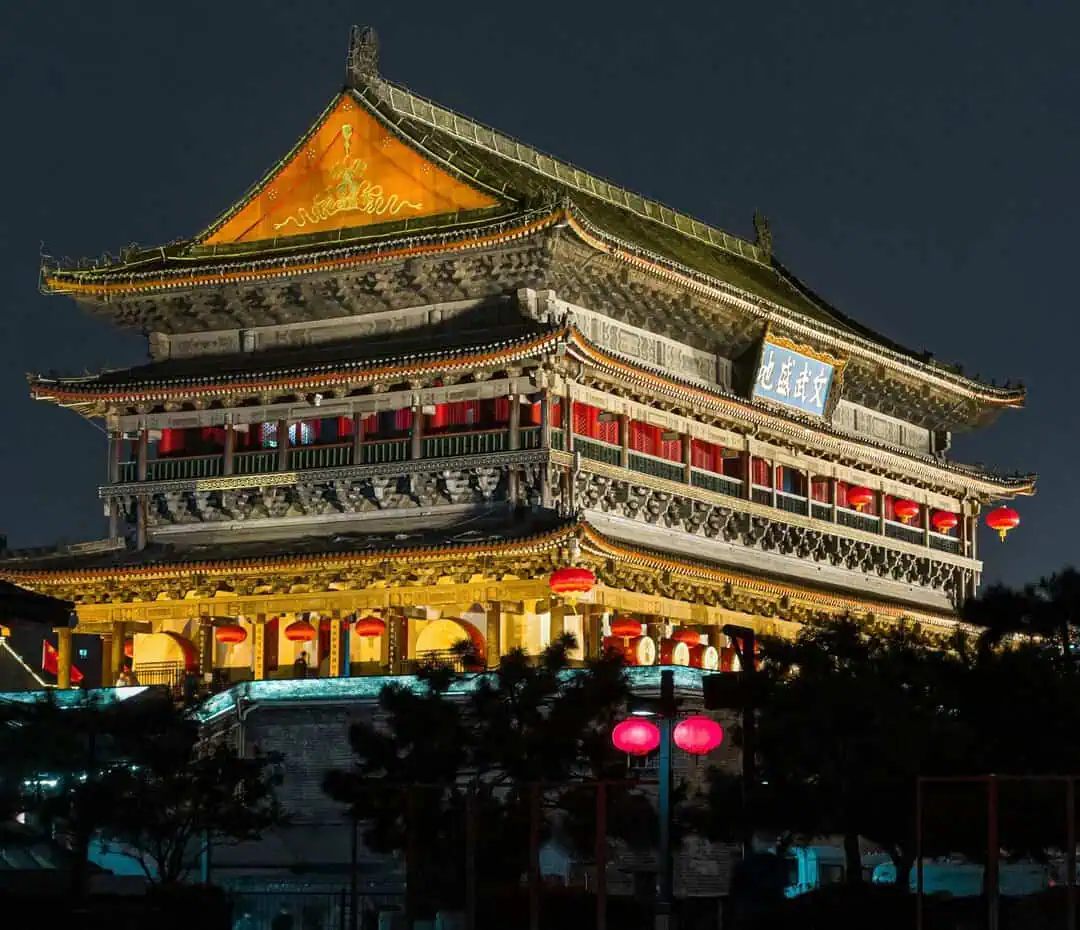
Xi'an Drum Tower
Xī'ān Gǔlóu
Built in 1380, four years before its famous sister — the tower whose drums closed every Xi'an day, and the gateway to the Muslim Quarter.
Entry
From ¥30
Hours
Apr 1 – Oct 10 · 8:30
Time needed
30 min–1 hours
Booking
Required · 3 days ahead
Metro
Line 2 · Zhonglou (钟楼) · C
Beating time over the city since 1380 — four years before the Bell Tower went up 200 meters away — the Drum Tower is the better of the two interiors: short drumming performances still run through the day, the drum collection inside is genuinely interesting, and the balcony looks straight down the grey rooftops of the Muslim Quarter. Time your visit to a performance, then walk out the back into the food lanes — this tower is a waypoint, not a destination, and it's all the better for it.
What you're looking at
The Drum Tower (鼓楼, Gǔlóu) went up in 1380, four years before its sister, and formed the evening half of the city's timekeeping system: "morning bell, evening drum" (晨钟暮鼓, chén zhōng mù gǔ). The bell in the Bell Tower announced the day; the great drums here closed it. The tower was renovated twice under the Qing (1699 and 1740) but keeps its Ming bones — a 34-meter timber structure in red and grey, built without iron nails, standing on a brick pedestal over 50 meters long.
Inside is effectively a small drum museum. The showpieces are the 24 drums flanking the hall, each painted with one of the 24 solar terms (二十四节气, èrshísì jiéqì) of the old agricultural calendar, plus a collection of drums from China's ethnic groups and dynasties — some exhibits centuries old. Up top, the balcony delivers the tower's best trick: looking north, the tiled roofs of the Muslim Quarter lanes spread out at your feet, with the Beiyuanmen food street directly below; look southeast and the Bell Tower fills the frame. In the lanes sits the Great Mosque, and the whole quarter is the living remnant of the Silk Road merchant communities that settled in Tang Chang'an.
Visiting strategy
Come for a performance. Costumed drummers with Tang-styled dancers play sets of about 10–15 minutes at intervals through the day — recently roughly every 45 minutes from about 9:30 into the late afternoon (9:30, 10:15, 11:00, 11:45, then afternoon sets from about 14:00). Schedules shift by season, so check the board at the ticket office and time your climb. Hearing the big drums hit inside the hall is the point of the visit.
Total time: 30–45 minutes. Exhibits, balcony, one performance. At ¥30 that's fair value, and the ¥50 combo with the Bell Tower makes both towers a cheap hour.
The natural route: the tower stands at the head of the Muslim Quarter — the Beiyuanmen (北院门) arch is at its back door. So the flow writes itself: late afternoon on the City Wall, Bell Tower at dusk, Drum Tower for a late performance, then down into the lanes for dinner. It's the exact arc of our Muslim Quarter food crawl.
Honest verdict: worth it — with the performance. Without drums, the interior is a pleasant 20 minutes and the balcony view is the main event. If you've just come from the Bell Tower's gallery, don't expect a different city from up top; expect a better soundtrack and a direct escalator-of-the-senses into dinner.
Getting there
The tower rises from the square 200 meters northwest of the Bell Tower, at the top of the Muslim Quarter.
- Metro: Line 2 or Line 6 to Zhonglou (钟楼) station; from the Exit C area it's a 5–10 minute walk west across the square — the tower is in front of you the whole way. See our getting around guide for metro basics.
- From the Muslim Quarter: you're already there — the quarter's main entrance arch stands at the tower's north side. Emergencies of appetite resolve in under two minutes.
- Taxi/DiDi: ask for 鼓楼. Drop-off is at the edge of the pedestrian square between the two towers; no cars enter the lanes behind it.
If you're pairing the towers with dinner, walk — the whole circuit (Bell Tower → Drum Tower → Beiyuanmen) is under a kilometer.
Practical notes
- Tickets: ¥30 at the tower office or via WeChat; ¥50 combo with the Bell Tower. No passport or advance booking needed.
- Performance times: posted daily at the ticket office; recently roughly every 45 minutes from about 9:30 to 16:20, 10–15 minutes each. Arrive 10 minutes early for a spot near the front of the hall.
- Stairs: the upper hall and balcony are stairs only. Street-level views of the tower (excellent after dark, when it's floodlit) are step-free.
- Toilets: scarce in the Muslim Quarter lanes — use facilities around the tower square or the Bell Tower malls before diving into dinner.
- Payments: tickets and every food stall beyond run on mobile payment.
- Evenings: the square between the towers is a relaxed local hangout after dark — dancers, kids with light-up toys, and both towers lit. Linger before heading into the lanes.
Questions, answered
What time are the drum performances at the Xi'an Drum Tower?
Recently roughly every 45 minutes through the day — about 9:30, 10:15, 11:00, 11:45, then afternoon sets from around 14:00 to 16:20 — each lasting 10–15 minutes. Schedules shift by season, so confirm at the ticket office when you arrive.
How much does the Xi'an Drum Tower cost?
Entry is ¥30, bought at the tower or via WeChat — no advance booking needed. A ¥50 combo covers both the Drum Tower and the Bell Tower, a five-minute walk apart. During the 2026 exhibition-hall renovation (Bell Tower 11 Oct–15 Nov; Drum Tower 1–30 Nov) the halls are closed, the second-floor viewing platform stays open and single-tower tickets drop from ¥30 to ¥15; the ¥50 combo is unchanged, and prices return when the halls reopen fully.
Which is better, the Bell Tower or the Drum Tower?
For interiors, the Drum Tower: it has the drumming performances, a small but genuine drum museum, and the balcony view over the Muslim Quarter. The Bell Tower wins on exterior drama, floodlit over its roundabout at night. The ¥50 combo makes doing both easy.
How long do you need at the Drum Tower?
30–45 minutes: the exhibition, the balcony, and one 10–15 minute drumming performance. It slots naturally between the Bell Tower at dusk and dinner in the Muslim Quarter, which begins at the tower's back door.
What is the connection between the Drum Tower and the Muslim Quarter?
The quarter's main food street, Beiyuanmen, begins at an arch directly behind the tower — the Drum Tower is effectively its gateway. Climb the tower for the rooftop view of the lanes, then walk out the back and eat your way through them.
What are the Drum Tower's opening hours?
Roughly 8:30–21:30 from April to early October, and 8:30–18:00 from mid-October to March, with ticket sales ending about 30 minutes before closing. The exterior is floodlit after dark and free to admire from the square.
What to notice when you get there
The evening half of Ming Xi'an's timekeeping — built in 1380, four years before the Bell Tower — and the gateway whose back arch opens straight into the Muslim Quarter.
Costumed drummers hitting great drums inside a nail-free timber hall until the floor carries the beat, then the balcony with the quarter's grey rooftops spread at your feet.
Time the climb to a performance — check the board at the ticket office — then walk out the back arch into Beiyuanmen for dinner; 30–45 minutes covers it.
Keep exploring

Xi'an City Wall
A 14-kilometer Ming dynasty rectangle you can cycle on top of — 650 years old and still the city's favorite commute.
Inside the walls · 1 km southwest of the Bell TowerLearn more →

Muslim Quarter
Feeding Xi'an since the 700s — the loudest, smokiest, best-smelling streets of its Hui community.
Inside the walls · 0.8 km west of the Bell TowerLearn more →

Xi'an Bell Tower
A Ming tower from 1384 at the dead center of the walled city — best admired at dusk, floodlit above the roundabout.
Inside the walls · 0.3 km west of the Bell TowerLearn more →

Great Mosque of Xi'an
A mosque founded under the Tang in 742 AD, dressed as a Chinese garden temple.
Inside the walls · 1.1 km west of the Bell TowerLearn more →

Forest of Steles (Beilin Museum)
Stone books since 1087 — nearly 3,000 steles, and the home of Chinese calligraphy itself.
Inside the walls · 0.8 km south of the Bell TowerLearn more →

Shuyuanmen Ancient Culture Street
The scholars' lane behind the South Gate — four centuries of brushes, inkstones and seal carvers at work.
Inside the walls · 1 km southwest of the Bell TowerLearn more →

Guangren Temple
A slice of Lhasa planted inside Xi'an's wall in 1705 — Shaanxi's only Tibetan Buddhist monastery.
Inside the walls · 1.5 km northwest of the Bell TowerLearn more →

Sajinqiao Food Street
The food street Xi'an locals actually eat at — ten minutes' walk and a world away from the Muslim Quarter's tourist strip.
Inside the walls · 1.4 km west of the Bell TowerLearn more →

Baxian An (Temple of the Eight Immortals)
Xi'an's working Taoist temple — centuries of incense, fortune-tellers, and almost no tourists.
Inside the walls · 1.9 km east of the Bell TowerLearn more →

Defu Lane
Xi'an's original coffee-and-cocktail street, one grey-brick block inside the South Gate.
1.7 km south of the Bell TowerLearn more →
Taibai Mountain
The roof of the Qinling — a 3,771 m giant with cable cars, a mandatory shuttle, and hot springs at the bottom.
109.4 km west of the Bell TowerLearn more →
More in Beilin District (碑林区)
Eat nearby
- Tongshengxiang (同盛祥): Paomo by the Bell Tower
A 1920 paomo institution on the square
- Lao Sun Jia (老孙家饭庄)
Paomo under the same name since 1898
- Jia San Guantang Baozi (贾三灌汤包子馆)
The Muslim Quarter's soup-dumpling landmark
- De Fa Chang (德发长): Xi'an's Dumpling Banquet
The 1936 house that turns dumplings into a parade
- Xi'an Restaurant (西安饭庄 Xi'an Fanzhuang)
The 1929 home of 'orthodox Shaanxi cuisine'
- Chang'an Dapaidang (长安大牌档)
Shaanxi food staged as a Tang night market
- Fan Ji Lazhi Roujiamo (樊记腊汁肉夹馍)
The Zhubashi benchmark pork 'Chinese burger'