
Visit Xi'an: The City ofTime
Three thousand years stacked into one walkable place — an army still on guard since 210 BC, a wall people still cycle on, a food street that has fed travellers since the Silk Road. The practical details are kept current.
Plan your trip
Start with the essentials
Xi'an in brief
Xi'an (西安) is the ancient capital of China and the eastern start of the Silk Road — the city where the first emperor's terracotta army still stands guard, where a 14 km Ming wall circles the old town, and where three thousand years of history sit inside one walkable centre. Most visitors come for the Terracotta Army and the city wall; they leave remembering the food streets and the Tang-dynasty evenings. Everything here is written on the ground, re-checked on a schedule, and priced in real yuan.
Xi'an at a glance
- Best time
- March–May and September–October
- Terracotta Army
- ¥120 · passport booking, reserve ahead
- City Wall
- ¥54 · bike hire about ¥45
- Airport
- XIY, about 40 km northwest · metro Line 14
- Getting around
- Metro ¥2–13 · DiDi · shared bikes
- Visa
- 50 countries visa-free for 30 days to 31 Dec 2026 · 240-hour transit for 57
- Money
- Alipay or WeChat Pay with a foreign card · cash rarely needed
- Language
- Mandarin · English signage is thin outside hotels
- Where to stay
- Inside the wall near the Bell Tower, or Qujiang
- Daily budget
- ¥300–450 budget · ¥900–1,400 comfortable
The big six
Xi'an's top sights.
The six spectacles people cross the world for — scroll through them at full size, then go see them standing up.
 Empire Time · 210 BCThe Terracotta ArmyEight thousand men, still on guard — every face different, none finished marching.Explore
 Wall Time · the 1370sThe City WallFourteen kilometers of Ming rampart — and the best bike ride in China.Explore
 Golden Time · the Tang, on waterThe Song of Everlasting SorrowChina's original open-air epic, staged on the very lake where the love story drowned.Explore
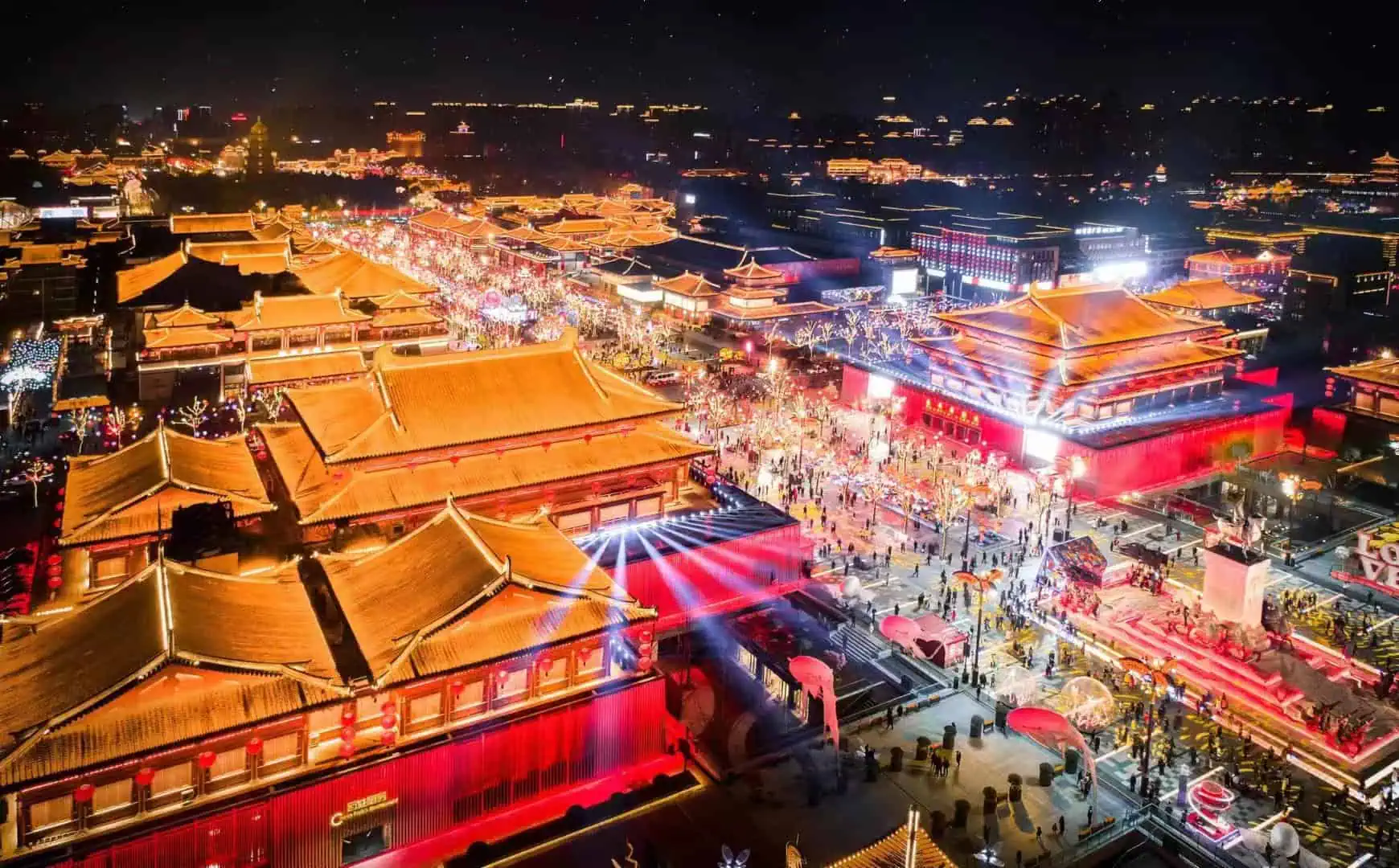 Current Time · Tang, rebootedGrand Tang Ever-Bright CityTwo kilometers of light, hanfu and street theater — the whole city out for a walk.Explore
 After dark · the stage epicsEpics After DarkFrom the Tang palace show to the new Qin mega-spectacle Jiu Jiu Da Qin (《赳赳大秦》) — this city does its history at full volume.Explore
 Deep Time · the sacred west peakMount HuashanPlank paths bolted to a granite cliff, two hours from downtown by bullet train.Explore
Start here
Visas, payments, trains, bookings — the 2026 logistics, in the order you'll actually need them.
Must-see sights
Five stops, five chapters of time — with honest verdicts, not hype.
Culture & history
Museums, steles and temples for the culture-first traveler — in the order we'd walk them.

- 02Shaanxi History Museum1.7 million relics under one roof — book the free ticket days ahead.
- 03Small Wild Goose Pagoda & Xi'an MuseumThe calm Tang pagoda, plus the free city museum nobody queues for.
- 04Daxingshan TempleThe Tang monastery where Japan's Shingon Buddhism began.
- 05The Great Mosque1,300 years of Silk Road Islam, built like a scholar's garden.
- 06Banpo MuseumA 6,000-year-old village, preserved exactly where it stood.


What to eat in Xi'an
Xi'an runs on wheat, lamb, chili and aged vinegar — proudly local, but this Silk Road capital has fed every kind of traveler for 1,300 years. Halal, vegetarian and cautious eaters all leave full.
 Roujiamo
 Biangbiang Noodles
 Yangrou Paomo
 Liangpi (Cold-Skin Noodles)
 Guantang Baozi (Soup-Filled Buns)
 Shizi Bing (Fried Persimmon Cakes)
 Hulutou
The pillar page
The complete Xi'an food guide
25 dishes, 5 eating guides, halal & vegetarian — with the Chinese names to point at.
Days across the centuries
14 field-tested routes, from one market morning to a mountain weekend — pick a layer of time, or take them all.
All trips · 14
1 dayPacked paceXi'an in 1 Day: The Greatest-Hits SprintRead the route 1 dayRelaxed paceOne Day Like a Local: Xi'an Off the PostcardRead the route
 1 dayRelaxed paceRainy day activities in Xi'an: the all-weather indoor routeRead the route
 1 dayPacked paceXi'an in Half a Day: The 4-Hour Hit ListRead the route1 dayRelaxed paceYour First Night in Xi'an: the landing-day playbookRead the route1 dayStandard paceInside the City Wall on Foot: Morning Market to Barbecue AlleysRead the route2 daysStandard paceXi'an in 2 Days: The Essential Weekend ItineraryRead the route2 daysStandard paceXi'an Visa-Free Layover: 24–72 Hours Without a VisaRead the route2 daysPacked paceThe Mountain Weekend: Zhongnan & Huashan from Xi'anRead the route
 2 daysRelaxed paceXi'an with kids: a relaxed 2-day family routeRead the route
 3 daysStandard paceXi'an in 3 Days: The Flagship First-Timer ItineraryRead the route
 3 daysStandard paceThe Connoisseur's Circuit: Xi'an for Culture LoversRead the route
 5 daysRelaxed paceXi'an in 4–5 Days: The Full Spread, With Mount HuashanRead the route7 daysStandard paceSeven days in Xi'an: the core plus the escapesRead the route
Xi'an city walks: self-guided, with a sense of purpose.
6 themed walks through the old city, picked by what you want from the next two hours — not by ticket offices. Every stop opens a full, fact-checked page.
Xi'an travel FAQ
- Is Xi'an worth visiting?
- Yes — it is the ancient capital of China. The Terracotta Army, a complete Ming city wall you can cycle, and the Silk Road's starting point are all here. Two or three days covers the headline sights; five lets you add Huashan or Luoyang.
- How many days do I need in Xi'an?
- Two full days for the essentials: the Terracotta Army, the city wall, the Muslim Quarter and the Shaanxi History Museum. Add one day for Huashan or a second museum, and two more for Luoyang or Pingyao.
- Do I need a visa to visit Xi'an?
- Citizens of 50 countries — including the UK, Canada, Australia and most of the EU — can enter China visa-free for up to 30 days until 31 December 2026. Everyone else, including US passport holders, needs a visa or the 240-hour visa-free transit.
- What is the best time to visit Xi'an?
- Spring (March–May) and autumn (September–October) have the mildest weather. Summer is hot and crowded; winter is cold and cheap, with the City Wall lantern festival opening in January.
Xi'an on video
Vlogs, food walks and shorts that show Xi'an as it really is — its food streets, the city wall at dusk, Tang-era nights and the warriors up close.
Shaanxi folk culture
The Eight Oddities of Shaanxi
Why the noodles run wide, the bread runs huge and the opera is roared — the folk verses that decode Guanzhong, each with a place to see it today.
01Noodles as wide as a trouser beltOrder one bowl first — it is a full meal; add a dish only if sharing.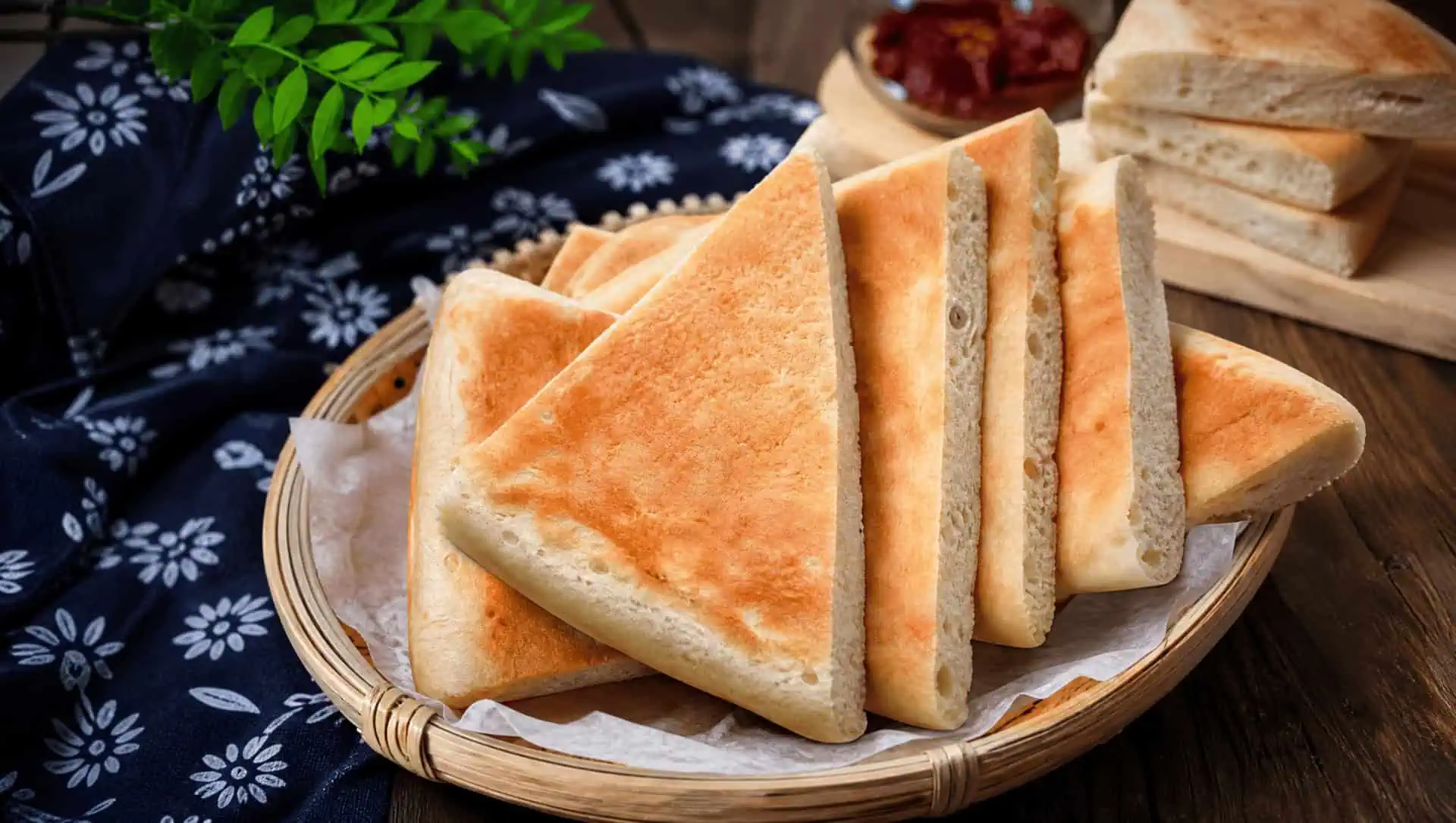 02Bread as large as a pot lidGuōkuī (锅盔) is a thick wheat flatbread, classically 30–40 cm across — the size of the pot lid it's named after.03Chili served as a dish, not a condimentElsewhere chili sits in a shaker; in Guanzhong, a bowl of chili in oil is served like a salad — the saying goes 'chili IS a dish' (辣子是道菜).04Houses roofed on only one sideTraditional Guanzhong farmhouses are single-slope: the tall side faces the street, the low side drains into the courtyard.05Daughters who didn't marry far from homeThe verse says Guanzhong daughters married within the region — 'not to outsiders' (姑娘不对外).06The headscarf doing five jobs at onceLook for the 帕帕 kerchief on women 60+ with rural Guanzhong accents.07Squatting beats sittingThe verse: dèngzi bù zuò dūn qǐlái — not sitting on the stool, squatting instead (凳子不坐蹲起来).08The opera that is roared, not sungThe verse: Qínqiāng bù chàng hǒu qǐlái — Qinqiang isn't sung, it's shouted/roared (秦腔不唱吼起来).
Where the locals go
The lanes and markets we send our own friends to — few tickets, no queues, all flavor.
 Food streetSajinqiao Food StreetThe food street Xi'an locals actually eat at — ten minutes' walk and a world away from the Muslim Quarter's tourist strip.
 Morning marketXiaonanmen Morning MarketBreakfast at the foot of a 600-year-old wall — the best hour in Xi'an is over by 9 a.m.
 Thu & Sun marketXicang MarketCricket sellers, pigeon fanciers and junk stalls in the shadow of a Ming granary — Xi'an's oldest running flea market, two mornings a week only.
 Café & bar laneDefu LaneXi'an's original coffee-and-cocktail street, one grey-brick block inside the South Gate.
 Wall-side walkShuncheng LaneThirteen kilometers of slow life at the foot of the wall — and the South Gate stretch is its best kilometer.
 Heritage food courtYongxingfangAll 107 counties of Shaanxi's food packed into one walled block — touristy, efficient, and honestly useful.
Xi'an at night
The city changes clothes at 9 p.m. — lit-up towers, night markets, lantern-lit food courts and the bar lanes locals actually drink in.

The city, district by district
Each district adds its own layer to the city's 3,000-year stack. Six starting points below — the full set lives on the districts page.
The root of China
Why thirteen dynasties — and every great unified empire — chose this one plain.

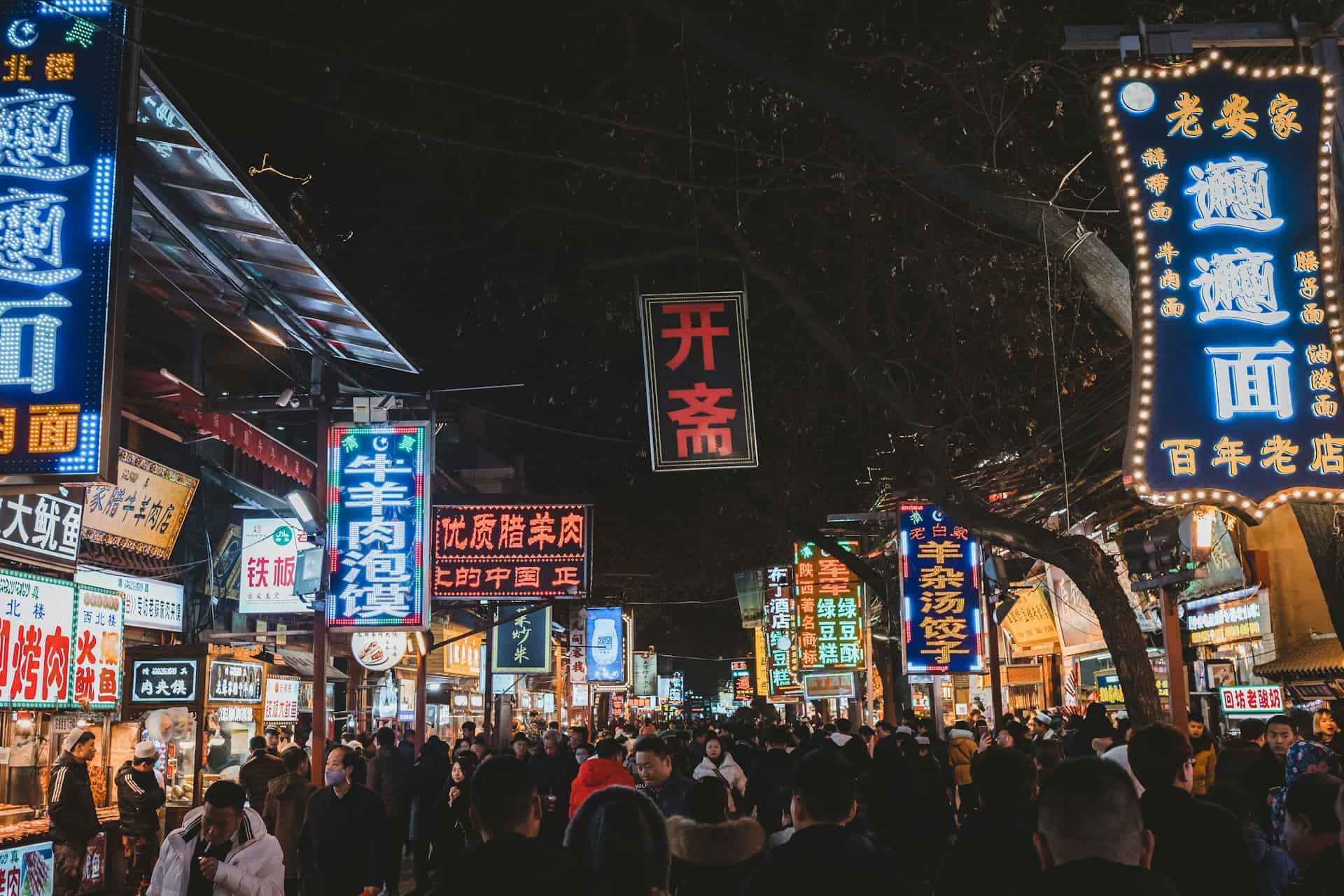 Xi'an and the Silk Road: where it all beganThe Silk Road had one fixed eastern anchor: Chang'an, today's Xi'an. Zhang Qian's accidental mission, the goods and ideas that moved both ways, the Sogdian middlemen — and the Hui quarter that remains its living legacy.
 Qin Shi Huang and the story of the Terracotta ArmyA 13-year-old king, a decade of conquest that created China, and a tomb built by 700,000 workers — then collapse, arson and 2,000 years of silence, until farmers digging a well in 1974 hit a terracotta head. The full arc of the First Emperor and his clay army.
 Chang'an in the Tang dynasty: the world's greatest cityA million people inside a 36-km wall circuit, 108 walled wards, two great markets, Persian silver in the shops and poetry on the wine-house walls — for three centuries Chang'an was the largest and most international city on Earth. How it worked, why it fell, and what it left in modern Xi'an's streets.