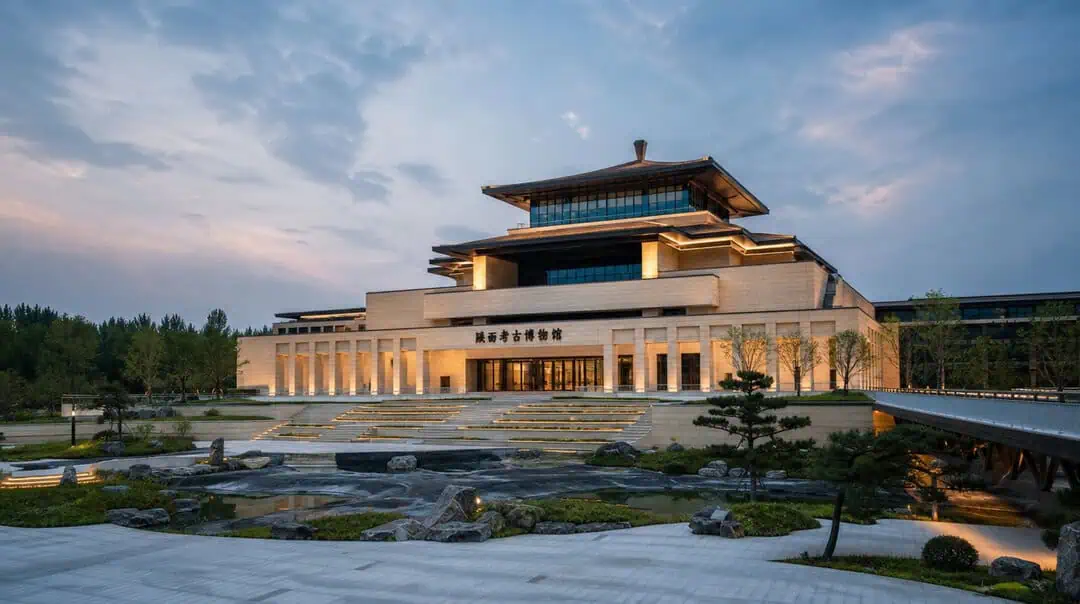
Shaanxi Archaeology Museum
Shǎnxī Kǎogǔ Bówùguǎn
China's first archaeology museum — not the treasures, but how they were found.
Entry
Free
Hours
Daily except Wednesday · 9:00
Time needed
1½–3 hours
Booking
Required
Metro
Line 2 · Weiqu South (韦曲南) · B
Opened in April 2022 out in southern Chang'an District, this is China's first museum dedicated to archaeological method. It is the complement to the Shaanxi History Museum: where that one displays the treasures, this one shows the trowels, the tombs as they were found, and the detective work behind 6,000 years of Shaanxi digs. It is free, but you must book a real-name slot and ride the metro south to get there — worth the trip for the archaeology-obsessed, skippable if you are short on time.
What makes it different
Most museums show you the object. The Shaanxi Archaeology Museum shows you how it got out of the ground. Run by the Shaanxi Academy of Archaeology and opened in 2022, it is China's first museum built around archaeological method — the digging, the lab work, the reconstruction.
The useful contrast is with the Shaanxi History Museum across town. That one is the greatest-hits reel: the treasure, polished, lit, captioned. This one is the making-of. Bronzes are displayed still crusted with the earth they were lifted in; tomb murals are shown half-conserved; cases explain how a shard becomes a dated artifact. If the History Museum answers what was found here, the Archaeology Museum answers how we know — and for a province that has been turning up world-class finds for a century, that turns out to be the more interesting question.
What to look for
The collection runs some 5,200 relics with around 4,200 on display, drawn from a century of Shaanxi digs and spanning the whole sweep — paleolithic Lantian material through Zhou bronzes to Tang tombs. A few things to seek out:
- The Shimao (石峁) carvings — eerie stone figures of a man shooting a horse from the ~4,000-year-old walled city in northern Shaanxi, a site that rewrote what we thought we knew about early Chinese civilization.
- Bronze weapons as found — Western-Zhou and Warring-States ge (戈, dagger-axes) shown with their soil and context, not prettied up.
- The conservation lab displays — the museum is unusual in showing you restoration in progress, not just the finished object.
- Tomb reconstructions — burials reassembled roughly as archaeologists met them, which reads very differently from a vitrine of clean treasures.
Plan 90 minutes to three hours. It is lightly visited compared with the marquee museums, which is part of the appeal — you can actually stand in front of things.
Getting in
Entry is free, but it is not walk-in. Reservations run only through official channels — the official booking site or the museum's WeChat mini-program (search 陕西考古博物馆); no third-party platform is authorized. Slots are released daily at 08:00, bookable up to 5 days ahead including the day of your visit (5 tickets per WeChat account), and weekend slots fill. Bring your passport — it is your ticket; visitors without a Chinese ID exchange it at the ticket booth west of the main entrance. The museum is closed Wednesdays, public holidays excepted.
Getting there
The museum is the one downside: it is well south, in Chang'an District, not the old city. The standard route is Metro Line 2 to Weiqu South (韦曲南), exit B, then either bus 738 (which stops at the museum door — 文苑路南口), bus 960 to 周家庄 plus an 800 m walk, or the Chang'an tourist shuttle (¥10) that runs from Weiqu South to the museum. By DiDi or taxi it is about 30–45 minutes from the Bell Tower. Pair it with nothing else in the immediate area — it is a dedicated half-day out and back.
Questions, answered
Is it really free?
Yes — entry is free, but you must book a real-name timed slot in advance and bring your passport. Without a reservation you will not get in.
How does it compare to the Shaanxi History Museum?
Different angle, not a substitute. The History Museum is the treasures; the Archaeology Museum is the method — how finds were excavated, conserved and dated. First-time visitors should do the History Museum; the Archaeology Museum is for a second day or the archaeology-curious.
Is it worth the trip out to Chang'an District?
If you have a free half-day and any interest in archaeology, yes — it is lightly crowded and genuinely unlike any other museum in the city. If you are on a tight first-visit schedule, skip it and spend the time inside the wall.
How do I get there?
Metro Line 2 to Weiqu South (韦曲南), exit B, then bus 738 (direct to the door) or the ¥10 tourist shuttle. About 30–45 minutes from the city center.
What to notice when you get there
China's first archaeology museum, opened 2022 — where the History Museum displays the treasures, this one shows the trowels, tombs as they were found, and the detective work behind 6,000 years of Shaanxi digs.
Bronzes still crusted with the earth they were lifted in, murals shown half-conserved, dim galleries that feel like the lab after the dig.
Book your free slot when tickets drop at 08:00 (up to 5 days ahead), ride Line 2 to Weiqu South and bus 738 to the door, and read it as the making-of companion to the Shaanxi History Museum.
Keep exploring
Guanzhong Folk Art Museum (关中民俗艺术博物院)
Forty Ming–Qing courtyards and a forest of stone hitching posts
29.1 km south of the Bell TowerLearn more →
Qinling Four Treasures Science Park: pandas near Xi'an
Qizai the brown panda is 65 km away
62.1 km southwest of the Bell TowerLearn more →

Terracotta Army
8,000 life-sized soldiers buried for China's First Emperor — and still on guard 2,200 years later.
33.3 km northeast of the Bell TowerLearn more →

Shaanxi History Museum
Every layer of Xi'an's time stack under one roof — Zhou bronzes, Han gold and Tang treasure.
4.1 km south of the Bell TowerLearn more →

Forest of Steles (Beilin Museum)
Stone books since 1087 — nearly 3,000 steles, and the home of Chinese calligraphy itself.
Inside the walls · 0.8 km south of the Bell TowerLearn more →

Hanyangling Mausoleum
A Han emperor's underground court, begun in 153 BC — half-sized figures under a glass floor, without the crowds.
20.4 km north of the Bell TowerLearn more →

Banpo Museum
A 6,000-year-old village under one roof — moat, kilns, and the deepest layer of Xi'an's time stack.
10.1 km east of the Bell TowerLearn more →
Xi'an Museum (西安博物院)
The easy-to-book plan B beside the Small Wild Goose Pagoda
1.7 km south of the Bell TowerLearn more →
Gpark (Laochenggen)
Xi'an's open-air 'experience street' — where the city's west side eats, strolls and poses after dark.
2.4 km northwest of the Bell TowerLearn more →
Big Wild Goose Pagoda fountain show: times and tips
Xi'an's best free show — ten minutes, four times a day
4.8 km southeast of the Bell TowerLearn more →